Whole Wheat vs. Wheat
You mean there’s a difference?
When you look at the ingredients of a packaged bread in the grocery store, sometimes you may see “wheat”, “whole wheat”, a combination of the two, or “enriched wheat” listed. The difference between them is significant. Firstly, let’s start with the anatomy of a whole wheat berry also referred to as a kernel.
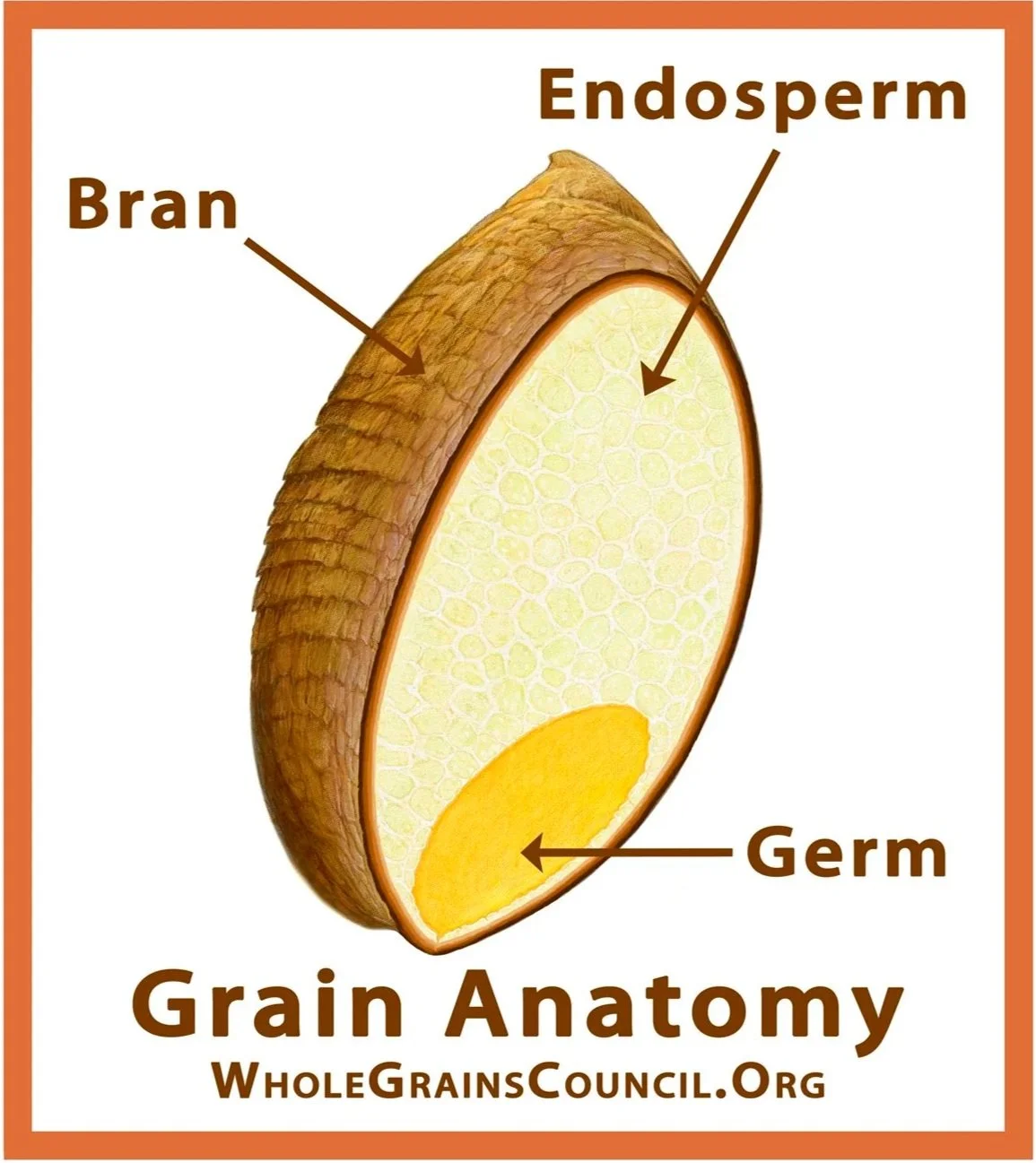
Anatomy of a Whole Wheat Berry
There are three main parts of the wheat berry:
(1) Bran - the outer protective skin containing antioxidants, B vitamins and fiber,
(2) Germ - the reproductive part of the berry, where a new plant begins to sprout and contains many B vitamins, minerals and some proteins,
(3) Endosperm - the wheat, where most of the protein and starchy carbohydrates exist to feed a newly sprouted plant.
Why separate the bran and germ?
Millers began separating the bran and germ from the endosperm because they found that these parts contained moisture and oils that caused freshly milled flour to go rancid if it wasn’t used quick enough. Endosperm, by itself, has a longer shelf life.
Every action has a reaction
By separating the bran and germ, the most nutritious part is removed. This became evident when widespead cases of pelagra (niacin deficiency) and beri beri (thiamin deficiency) plagued the United States in the early 1900s. Millers began fortifying their flour in 1941 after concerns over the health status of soldiers enlisting for World War II. Today any flour that is enriched is required to be identified in the ingredients.
What type of flour I use
All of my loaves are a blend of Central Milling’s Organic T85 Malted Wheat flour and 100% Whole Wheat flour, with the exception of my 100% Whole Wheat Honey loaf, which is 100% Whole Wheat flour. When I blend the two flours it allows me to achieve a higher nutritional value without compromising on the lighter texture many people are accustomed to.